In Indonesia the outdoor play business is not won by the tallest ride. It is won by shade, drainage and equipment that still looks new after two wet seasons. That is why a non-powered park – what Indonesian families simply call taman bermain – can open on a fraction of a ride park’s capex and still carry a full weekend of families.
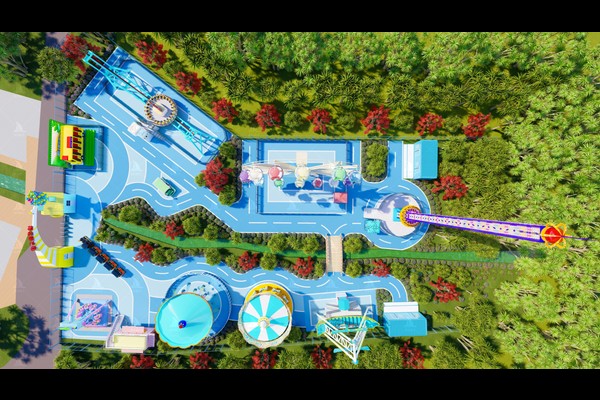
1,000 m² is the practical minimum. Below that you cannot separate toddlers from older children, and the site reads as a playground corner rather than a destination. Above 3,000 m² the economics change again: you need parking, F&B and staff to match. This guide covers the 1,000-2,000 m² band where most Indonesian projects sit.
Why Non-Powered Parks Work in This Climate
- Capex per square metre is a third to a half of a mechanical ride park, and it is spent on things guests touch.
- Staffing is supervision, not operation – no ride operators, no daily mechanical checks, no height restrictions to police.
- Maintenance is visible. A worn bearing on a slide tower is seen, not diagnosed; there is no hydraulic system to fail quietly.
- Every age uses the same site, so one ticket covers a family group rather than one child.
- It can open in phases – core play today, water play next year, funded by the first season.
It also pairs well with an indoor venue: the same operator can run a mall indoor playground for wet-season weekdays and an outdoor taman bermain for weekends and holidays.
何 1,000 m² Actually Contains
| Zone | エリア | Notes |
|---|---|---|
| Toddler zone | 150-200 m² | 0-3 年, soft surfacing, seating with a direct sight line |
| Main play structure | 300-400 m² | タワー, tube slides and netting across two or three levels |
| Climbing and ropes | 150-200 m² | 5-12 年; fall-height surfacing is mandatory here |
| ブランコ, seesaw, sand | 100-150 m² | The classic pieces families look for first |
| Water play (optional) | 100-150 m² | Splash pad, pump room, filtration and drainage |
| シェード, 座席, F&B | 150-200 m² | Where parents spend money while children play |
| 循環 | 20-25% of total | Prams, queues, staff access and emergency egress |
Two layout rules matter more than the equipment list. Put the toddler zone beside seating, not at the far end of the site; and route guests past the ticket desk and the cafe on the way in, not only on the way out. A park where parents cannot sit and see three zones at once loses dwell time.
Equipment Budget per Square Metre
| 標準 | What it includes | Indicative equipment rate |
|---|---|---|
| Basic | ブランコ, スライド, sand play, simple climbers | 米ドル 45-70 per m² |
| Themed | タワー, multi-lane slides, rope course, テーマ | 米ドル 70-110 per m² |
| サイン | Rainbow slide world, tall tower, custom theme | 米ドル 110-160 per m² |
Multiply the rate by your play area, then add the three lines that are always underestimated: 表面化 (wet-pour rubber or EPDM, roughly USD 25-45 per m²), drainage and earthworks, そして shade. On a 1,000 m² site those three can add 25-35% to the equipment figure, and they are the parts that decide whether the park survives its first rainy season.
The rate above is for the play area only, not the whole plot. 造園, car park, perimeter fence and the ticket building are separate. If you want a rainbow slide as the signature piece, を見てください Indonesia rainbow slide project for how the lanes, tower and landing zone were laid out.
Designing for Heat, Rain and Salt Air
Indonesian outdoor equipment fails in three predictable ways: UV, water and heat. Address them at design stage and the maintenance budget stays small.
- シェード 40-60% of the play area. Steel handrails in direct sun can exceed 70°C; shade is a safety measure, not a comfort extra.
- Drain for 100 mm of rain per hour. Fall the surface 1-1.5% away from equipment, and no ponding within 3 m of any footing.
- Specify hot-dip galvanising of at least 80 microns そして 304 stainless fasteners; coastal sites in Bali and Makassar need this, not just the coast.
- Use HDPE board for hand-contact surfaces and UV-stabilised colour; powder coating is for structure, not for sliding surfaces.
- Choose surfacing by fall height: wet-pour rubber or EPDM; artificial turf only over a shock pad with a drainage layer.
The Revenue Model, With the Assumptions Stated
| Line | Planning assumption |
|---|---|
| Ticket price | 米ドル 1.5-3 per child, adult free |
| Weekend traffic | 250-600 visits per day |
| Weekday traffic | 60-150 visits per day |
| Operating days | 26-30 per month |
| Operating cost | 45-55% of revenue (スタッフ, 力, water, maintenance, marketing) |
| Payback target | 18-30 months on equipment, 表面と日陰 |
These are planning assumptions from our project work, not a promise for your site. Rent is the variable that decides the outcome: the same park can pay back in two years on a suburban plot and never pay back inside a mall service charge structure. Build the model with your actual rent, then decide the size.
Phasing the Build
Phase 1 is a complete guest experience on day one: core play, 幼児ゾーン, shade, toilets and a ticket booth. Do not open with a construction fence around half the site.
Phase 2, usually month 6-12, adds the piece the first season proved people want – water play or a rope course – and is funded by phase 1 cash flow rather than a second loan.
Phase 3 is the commercial layer: カフェ, party deck, school-holiday events. That is the phase that lifts revenue per visit without adding play capacity.
規格, Safety and Inspection
Non-powered does not mean unregulated. Equipment should be designed to で 1176, with surfacing selected against the critical fall height in EN 1177. Ask for a fall-height certificate per platform and a load calculation for any tower above 3 m. Keep a daily checklist (loose bolts, worn surfacing, broken netting) and a monthly log – inspectors ask for the log, not the brochure.
For the licensing path before you build, see how to open an amusement park in Indonesia, and for the commercial comparison between park models, の 2026 investment guide.
A Common Question: “Harga Taman Bermain”
Indonesian buyers usually open with harga taman bermain – the price of a playground. The honest answer is that the equipment is roughly 60-70% of the outdoor project, and the rest is what makes it a business: 表面化, 排水, shade, fencing, 点灯, toilets and the ticket gate. Ask for a quotation that lists all of it, or the first number you receive will be followed by three more.
Equipment is produced and load tested at our 125,000 m² 工場, then packed for container shipment; の 遊具メーカー team can also review your site plan before you commit to a layout.
Send the plot dimensions, the budget you have approved and the opening date you are working towards. We will return a zone plan, an equipment list with rates per square metre, and a phasing proposal you can take to your bank.